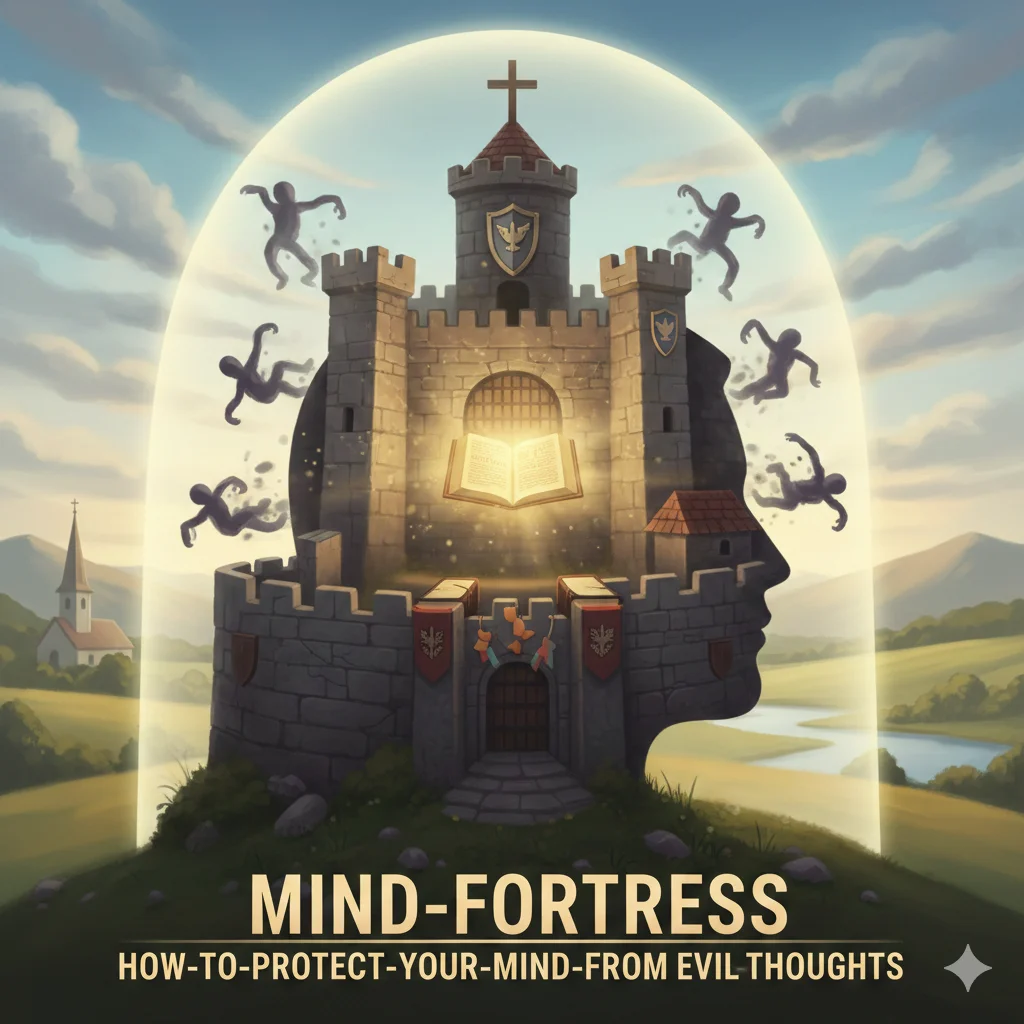
In the quiet chambers of the human heart, a silent war is waged every second of every day. It is a conflict not of flesh and blood, but of ideas, impulses, and spiritual influences. For the Christian, the mind is the primary battlefield where the destiny of the soul is often decided.
The Apostle Paul, writing to the church in Corinth, did not mince words: "For though we walk in the flesh, we do not war according to the flesh. For the weapons of our warfare are not carnal but mighty in God for pulling down strongholds" (2 Corinthians 10:3-4).
If you find yourself besieged by intrusive thoughts, patterns of negativity, or "evil thoughts" that seem to bubble up from an unknown well, you are not alone. But more importantly, you are not defenseless. Protecting your mind is not merely about "thinking positive"; it is about spiritual architecture—building a fortress that the enemy cannot penetrate.
I. Understanding the Anatomy of a Thought
To defeat an enemy, you must first understand how they operate. In the Christian worldview, "evil thoughts" typically stem from three primary sources: The World, The Flesh, and The Devil.
1. The World (External Influence)
We live in a sensory-saturated age. Every advertisement and algorithm is designed to bypass your logic. If you do not curate your environment, your mind will naturally reflect the chaos around you.
Sanctuary Tip: Create a physical environment that reminds you of peace. Browse our Sanctuary Collection for apparel that anchors your focus.
2. The Flesh (Internal Propensity): Our brains have "grooves"—neural pathways—formed by years of past habits. These paths are the path of least resistance for evil thoughts.
3. The Devil (Spiritual Attack): Satan is the "accuser." He whispers in the first person: "I am a failure." By using "I" statements, he deceives you into thinking his suggestions are your own original thoughts.
II. The Doctrine of "Logismoi"
The Desert Fathers identified a specific progression of how an evil thought takes root. Understanding this progression is the key to early intervention.
- 1. Provocation (Prosbole): The initial suggestion. At this stage, there is no sin.
- 2. Coupling (Syndyasmos): When you begin to "talk" to the thought. You entertain it.
- 3. Assent (Synkatathesis): The moment the will decides to act on the thought.
- 4. Captivity (Aichmalosia): When the thought becomes a stronghold.
The Strategy: The goal is to "cut off" the thought at the stage of Provocation. If you wait until the stage of Captivity to fight, the battle is exponentially harder.
III. Practical Strategies for Fortification
1. The Law of Replacement
You cannot simply "stop" thinking a thought. The human brain functions by substitution. To remove an evil thought, you must replace it with a superior one.
2. Guarding the Gates
Your mind processes what you feed it. If you spend hours consuming secular media, you cannot expect a pure prayer life. You need a system to organize your spiritual inputs.
Need a System?
Don't rely on willpower. Use our Kingdom Planner to structure your daily prayer and inputs.
GET THE PLANNER →3. The Power of Audible Scripture
When Jesus was tempted, He didn't just "think" the truth—He spoke it. There is power in the spoken Word. When an evil thought attacks, speak a verse out loud to break the loop of rumination.
IV. Dealing with Intrusive Thoughts (OCD)
It is vital to distinguish between willful evil thoughts and intrusive thoughts. If a thought causes you distress and you hate it, it is likely an intrusive thought, not a reflection of your heart.
"God knows the difference between a 'fiery dart' from the enemy and the 'intentions of the heart' (Hebrews 4:12)."
In these cases, the best protection is to disregard the thought. Treat it like "brain static" and redirect your focus to Christ's finished work.
Common Questions
Is an evil thought a sin?
No. A thought only becomes sin when it is embraced, entertained, or acted upon. Even Jesus was tempted (Hebrews 4:15), yet He remained without sin because He never gave those thoughts harbor.
Why do bad thoughts increase when I pray?
This is spiritual pushback. When you begin to seek God, you move against the "current" of this world. The enemy uses distraction specifically during prayer to make you feel unworthy.
How do I know if it's the Devil or me?
The Enemy (Accuser): Thoughts are vague, destructive ("You are a failure"), and produce shame.
The Holy Spirit: Conviction is specific ("You shouldn't have said that to your wife"), leads to repentance, and ends in hope.
Equip Your Spirit
Protecting your mind is a marathon. There will be days when the "darts" seem to get through. But remember: your standing before God is based on Christ’s righteousness, not the perfection of your thought life.
Recommended Tools